Until now, everything a nation's mines and wells produced went straight into one shared stockpile, wherever they stood. Now it matters where things are made and how they reach the towns: a mine at the end of a long road produces less, a cut road or a bombed bridge costs production, and weapons come out of factories that can be bombed. All of this is in the living world; War mode keeps its three resources.
Version française plus bas.
Roads that matter
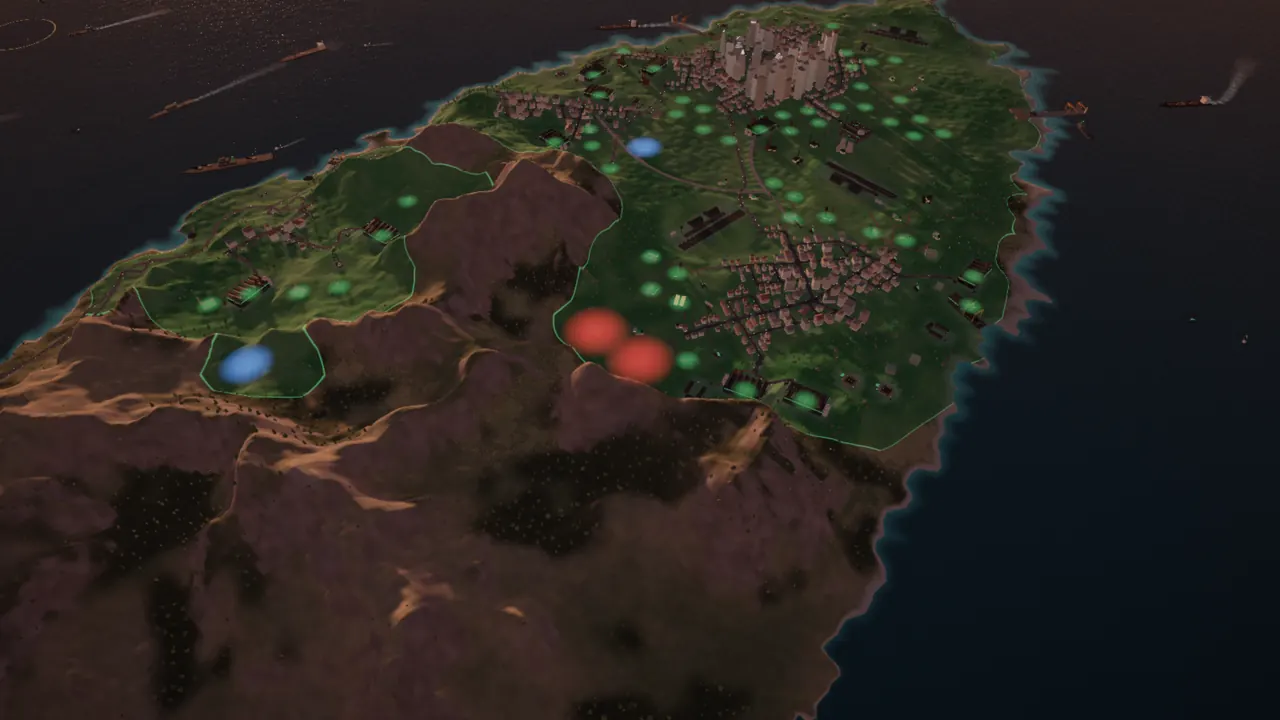
The new Logistics map: two works cut off from the towns stand out in red, the warehouses in blue.
La nouvelle carte Logistique : deux exploitations coupées des villes ressortent en rouge, les entrepôts en bleu.
- Every mine, well, farm and factory now produces according to the road that links it to a town of its nation: full output up to 3 km, falling to half at 10 km, 30% with no road at all. Only a works right on its town's edge needs no road.
- A bridge destroyed or a road cut by the war makes the way longer or breaks it, and production drops. Cutting a road is now a real blow.
- A new Logistics map mode (Map menu): a faint green dot on each works well linked, a yellow or red halo on those far or cut off, the warehouses in blue, each nation tinted by how well its works are linked. The nation sheet says how many of its works are badly linked.
Deposits
- Oil and uranium now lie in real deposits drawn from each map's seed: oil in the low plains and along the coasts, uranium in the hills. Rarer, but richer. On the Resources layer (R), oil shows in blue and uranium in lime.
- Works and factories produce a quarter more, and nations put them near what feeds them and near a road: a factory near its ore, a coal plant near a mine, an oil plant near a well.
Supply chains
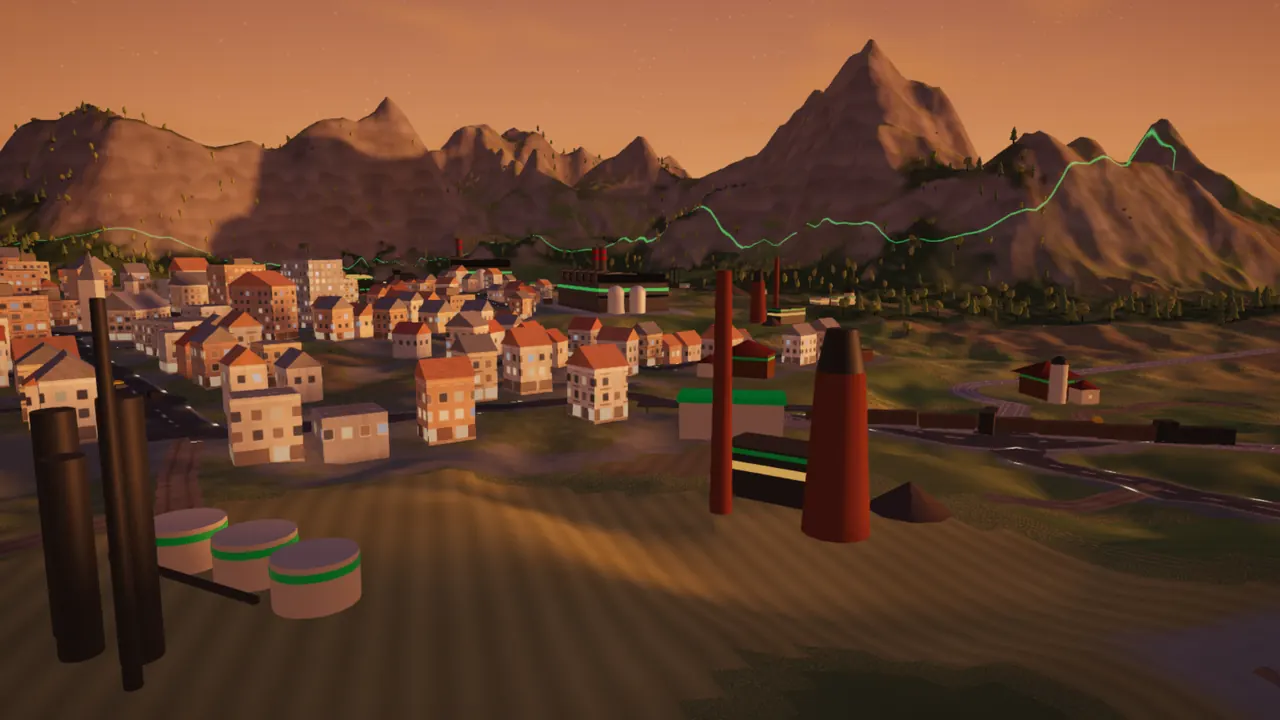
A refinery and a steelworks on the edge of a town, more of the chain beyond.
Une raffinerie et une aciérie en lisière de ville, la suite de la chaîne plus loin.
- Five new buildings. From the industrial age: the steelworks (ore into steel, needs power), the refinery (oil into fuel), the munitions works and the arms works (steel and industry into munitions and arms). From the atomic age: the enrichment plant (uranium into enriched uranium, needs power).
- The arsenal pays in munitions and enriched uranium, the reserve, the units and the warships in arms and fuel, and an army in the field eats munitions and fuel.
- Without the chain, a nation pays in raw materials at double the price, like a makeshift workshop. Building the chain halves the price of its weapons; losing it, bombed or cut off from its ore or its oil, doubles it again.
- The computer builds its chains in order (steel before arms), near what feeds them, and no more factories than its steel can run.
- No fixed ceiling: a nation keeps adding munitions or arms works only while it uses up what they make. When it needs something and has no room left, a works it has more of than it uses gives way to it, for part of its price back, and the news says so. A kind pulled down is not rebuilt for ten years, so nothing is torn down and raised again in turn.
- At war, these buildings are targets for raids and missiles, like the power plants.
Warehouses
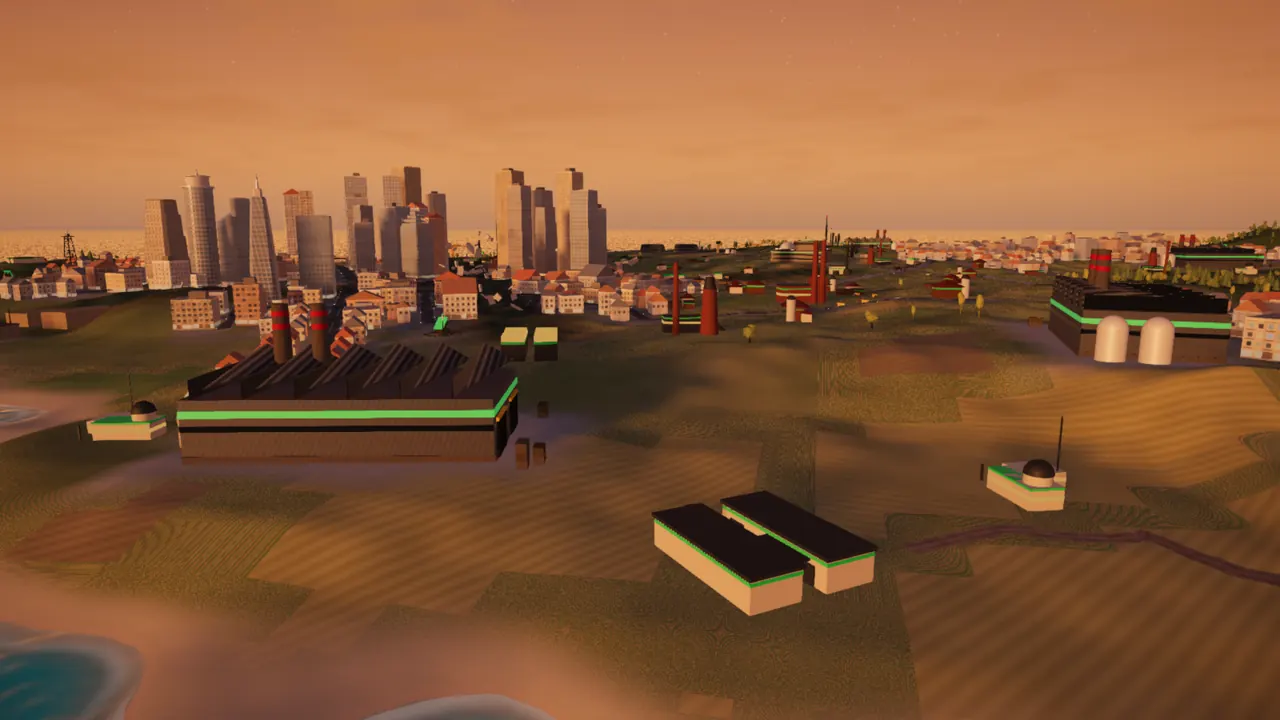
A warehouse in the foreground, among the works whose loads it takes in, the city beyond.
Un entrepôt au premier plan, parmi les exploitations dont il reçoit les charges, la ville au loin.
- A new building: the warehouse. It houses workers and acts as a town for the works around it, so a cluster of mines far from any town becomes worth working. Its own road to a town counts for a third, since it ships in bulk.
- What the works around it make waits there for about a year before it reaches the towns. Taken or destroyed, the warehouse loses everything it holds: a target worth hitting.
- Cut its road to the towns, and the works around it fall to 30%.
Behind the scenes: what broke on the way
Not everything worked the first time, and the fixes are part of the story.
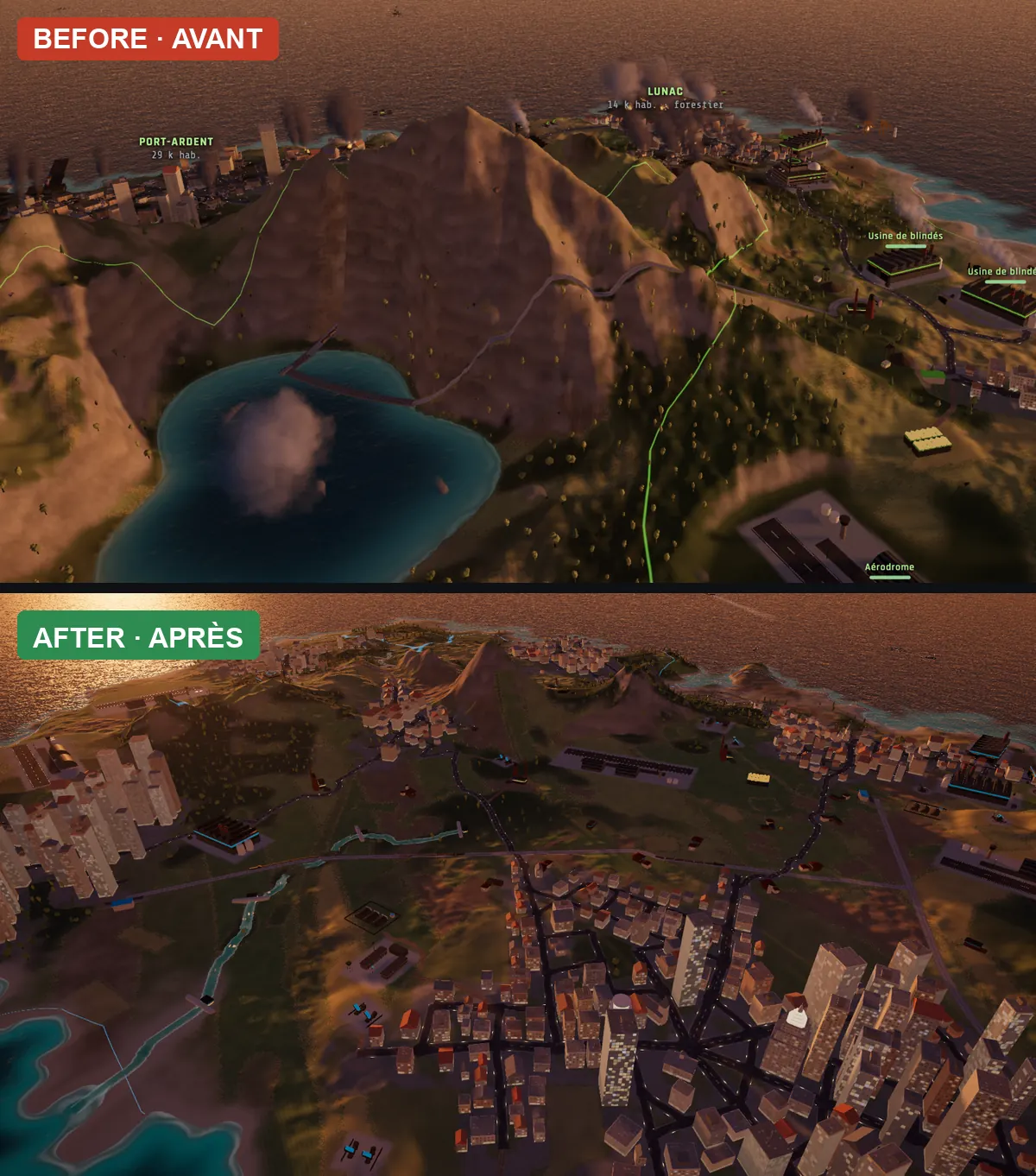
Railways: a line that ran straight over a mountain and across a lake in a test game, and the same rules now.
Le rail : une ligne qui passait droit sur une montagne et à travers un lac dans une partie de test, et les mêmes règles aujourd'hui.
- The first rules rounded the railway's bends without looking at the land: a line climbed a hill at nearly 50% and cut across a lake.
- Keeping to the land then made some lines loop round to come at a tunnel straight, and one joined another line deep inside its tunnel. Junctions now stay in the open.
- Forbidding that, with a 3.5% grade, left two nations with no railway at all on a hilly map. The grade is now 6%, a mountain railway's, and cuttings are no deeper than 8 m.
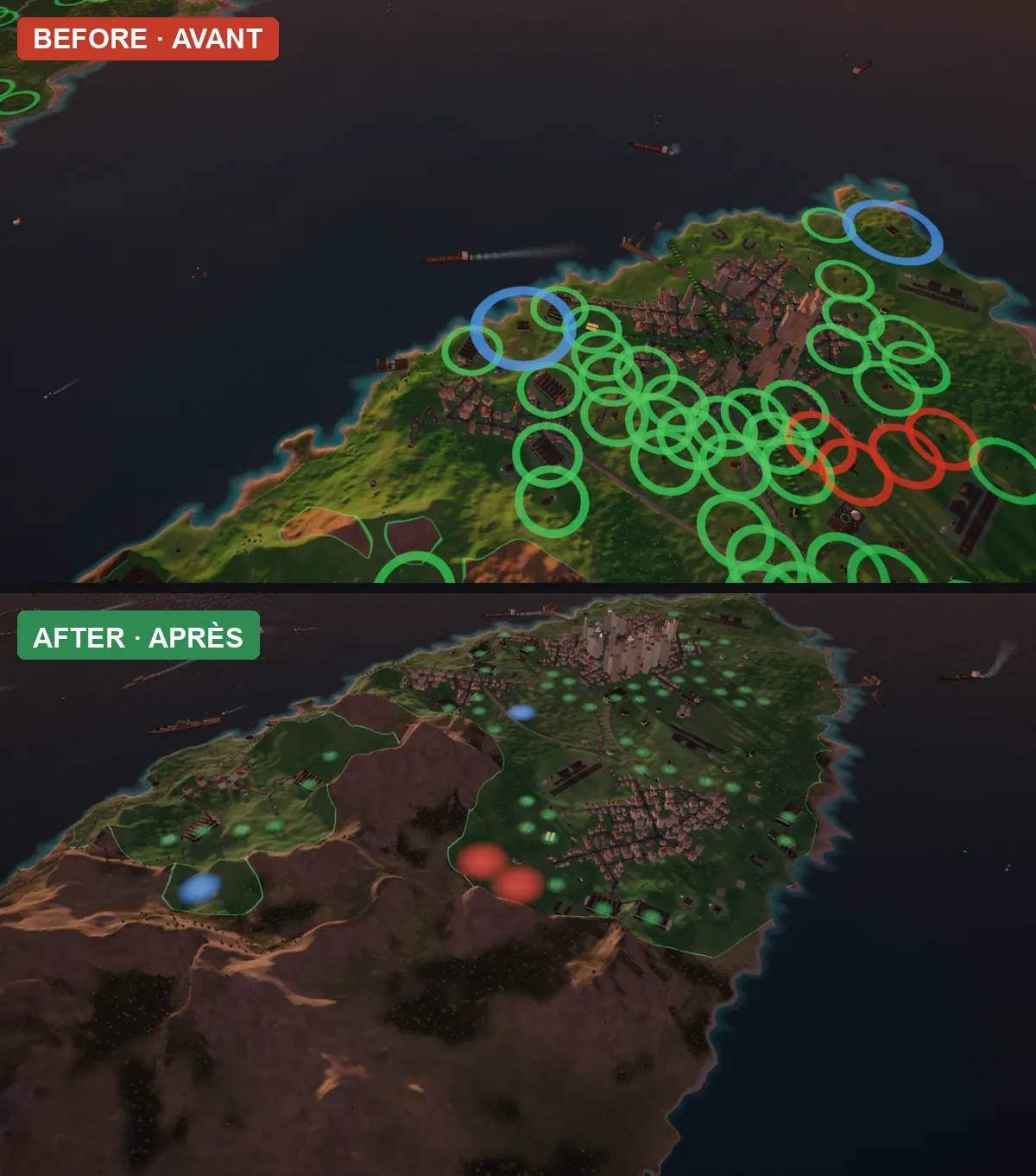
The Logistics map's first rings, and the soft marks that replaced them.
Les premiers anneaux de la carte Logistique, et les marques douces qui les ont remplacés.
- The Logistics map first ringed every works with a thick circle, the well linked ones too. Now what works is a faint dot and only what goes wrong stands out.
Also
- Railway lines keep their gentle grade round the bends (no more climbing straight over a hill), no longer cut across a lake, enter and leave their tunnels straight on, and skirt the towns; the houses still in their way make room when a line opens. A nation's network can start from any of its towns, and an island gets a network of its own. Lines keep off the roads, are never built between towns a few hundred metres apart (the lorries do that), and a town near a passing line gets its station on it.
- The news names every building a nation raises, and every works has its name on screen.
- Every window (Rules, Chronicle, the bill of a war) keeps its Close button in sight while you scroll it, like the menu's launch button.
- On iPhone, version 1.2.0 (aircraft carriers and what a front costs) is still with Apple for review. The supply chains will come in the next version.
Every game still draws a new world. Feedback is very welcome in the comments, especially on the balance: how much a far mine should lose, how dear weapons should be without the chain.
Version française
Chaînes logistiques : aciéries, entrepôts, et des routes qui comptent
Jusqu'ici, tout ce que produisaient les mines et les puits d'une nation allait droit dans un stock commun, où qu'ils soient. Désormais, l'endroit où l'on produit et le chemin jusqu'aux villes comptent : une mine au bout d'une longue route produit moins, une route coupée ou un pont bombardé coûtent de la production, et les armes sortent d'usines que l'on peut bombarder. Tout cela vaut pour le monde vivant ; le mode Guerre garde ses trois ressources.
Des routes qui comptent
- Chaque mine, puits, ferme et usine produit selon la route qui la relie à une ville de sa nation : production pleine jusqu'à 3 km, qui tombe à la moitié à 10 km, 30 % sans route du tout. Seule une exploitation collée à sa ville se passe de route.
- Un pont détruit ou une route coupée par la guerre allongent le chemin ou le rompent, et la production baisse. Couper une route est désormais un vrai coup.
- Un nouveau mode de carte Logistique (menu Carte) : un discret point vert sur chaque exploitation bien reliée, un halo jaune ou rouge sur celles qui sont loin ou coupées, les entrepôts en bleu, chaque nation teintée selon la façon dont ses exploitations sont reliées. La fiche de nation dit combien de ses exploitations sont mal reliées.
Les gisements
- Le pétrole et l'uranium sont désormais de vrais gisements tirés de la graine de chaque carte : le pétrole dans les plaines basses et le long des côtes, l'uranium dans les collines. Plus rares, mais plus riches. Au calque des ressources (R), le pétrole apparaît en bleu et l'uranium en vert citron.
- Exploitations et usines produisent un quart de plus, et les nations les placent près de ce qui les nourrit et près d'une route : une usine près de son minerai, une centrale à charbon près d'une mine, une centrale au fioul près d'un puits.
Les chaînes de production
- Cinq nouveaux bâtiments. Dès l'âge industriel : l'aciérie (du minerai à l'acier, il lui faut du courant), la raffinerie (du pétrole au carburant), l'usine de munitions et l'usine d'armement (de l'acier et de l'industrie aux munitions et à l'armement). Dès l'âge atomique : le centre d'enrichissement (de l'uranium à l'uranium enrichi, il lui faut du courant).
- L'arsenal paie en munitions et en uranium enrichi, la réserve, les unités et les navires de guerre en armement et en carburant, et une armée en campagne mange des munitions et du carburant.
- Sans la chaîne, une nation paie en matières brutes au double du prix, comme un atelier de fortune. Bâtir la chaîne divise par deux le prix de ses armes ; la perdre, bombardée ou coupée de son minerai ou de son pétrole, le double à nouveau.
- L'ordinateur bâtit ses chaînes dans l'ordre (l'acier avant l'armement), près de ce qui les nourrit, et pas plus d'usines que son acier ne peut en faire tourner.
- Pas de plafond fixe : une nation n'ajoute des usines de munitions ou d'armement que tant qu'elle consomme ce qu'elles produisent. Quand il lui faut un bâtiment et qu'elle n'a plus de place, une exploitation dont elle a plus qu'il ne lui en faut lui cède la sienne, contre une partie de son prix, et les nouvelles le disent. Un type démoli n'est pas reconstruit avant dix ans : rien n'est démoli puis rebâti en boucle.
- En guerre, ces bâtiments sont des cibles des raids et des missiles, comme les centrales.
Les entrepôts
- Un nouveau bâtiment : l'entrepôt. Il loge des ouvriers et sert de ville aux exploitations autour de lui : une grappe de mines loin de toute ville devient rentable. Son propre trajet jusqu'à une ville compte pour un tiers, puisqu'il expédie en gros.
- Ce que produisent les exploitations autour de lui y attend environ un an avant de rejoindre les villes. Pris ou détruit, l'entrepôt perd tout ce qu'il garde : une cible qui vaut le coup.
- Coupez sa route vers les villes, et les exploitations autour de lui tombent à 30 %.
Dans les coulisses : ce qui a cassé en route
Tout n'a pas marché du premier coup, et les corrections font partie de l'histoire.
- Les premières règles arrondissaient les virages du rail sans regarder le terrain : une ligne grimpait une colline à près de 50 % et coupait à travers un lac.
- Coller au terrain a ensuite fait faire des boucles à certaines lignes pour aborder un tunnel bien droit, et l'une d'elles rejoignait une autre ligne au fond de son tunnel. Les jonctions restent désormais à l'air libre.
- L'interdire, avec une pente de 3,5 %, a laissé deux nations sans aucun rail sur une carte vallonnée. La pente est désormais de 6 %, celle d'un chemin de fer de montagne, et les tranchées ne dépassent pas 8 m.
- La carte Logistique entourait d'abord chaque exploitation d'un gros anneau, même les bien reliées. Désormais ce qui marche est un point discret, et seul ce qui va mal ressort.
Et aussi
- Les voies ferrées gardent leur pente douce dans les virages (plus de montée droit sur une colline), ne coupent plus à travers un lac, entrent et sortent des tunnels dans l'axe, et contournent les villes ; les maisons encore sur leur chemin font place quand une ligne ouvre. Le réseau d'une nation peut partir de n'importe laquelle de ses villes, et une île a son propre réseau. Les voies évitent les routes, ne relient jamais deux villes distantes de quelques centaines de mètres (les camions s'en chargent), et une ville proche d'une ligne a sa gare dessus.
- Les nouvelles nomment chaque bâtiment qu'une nation élève, et chaque exploitation a son nom à l'écran.
- Chaque fenêtre (Règles, Chronique, bilan de guerre) garde son bouton Fermer en vue pendant qu'on la fait défiler, comme le bouton de lancement du menu.
- Sur iPhone, la version 1.2.0 (porte-avions et ce que coûte un front) attend toujours la validation d'Apple. Les chaînes logistiques arriveront dans la version suivante.
Chaque partie tire toujours un nouveau monde. Vos retours sont les bienvenus en commentaire, surtout sur l'équilibre : combien une mine éloignée doit perdre, combien les armes doivent coûter sans la chaîne.